

Teaching Without a Textbook
What should we do when one of our most important tools leads us astray?

I was all set to share my annual “How I’m Teaching English This Year” post this week to provide some food for thought to my fellow teachers, but then my friend Sam Rinko brought the headline below to my attention:
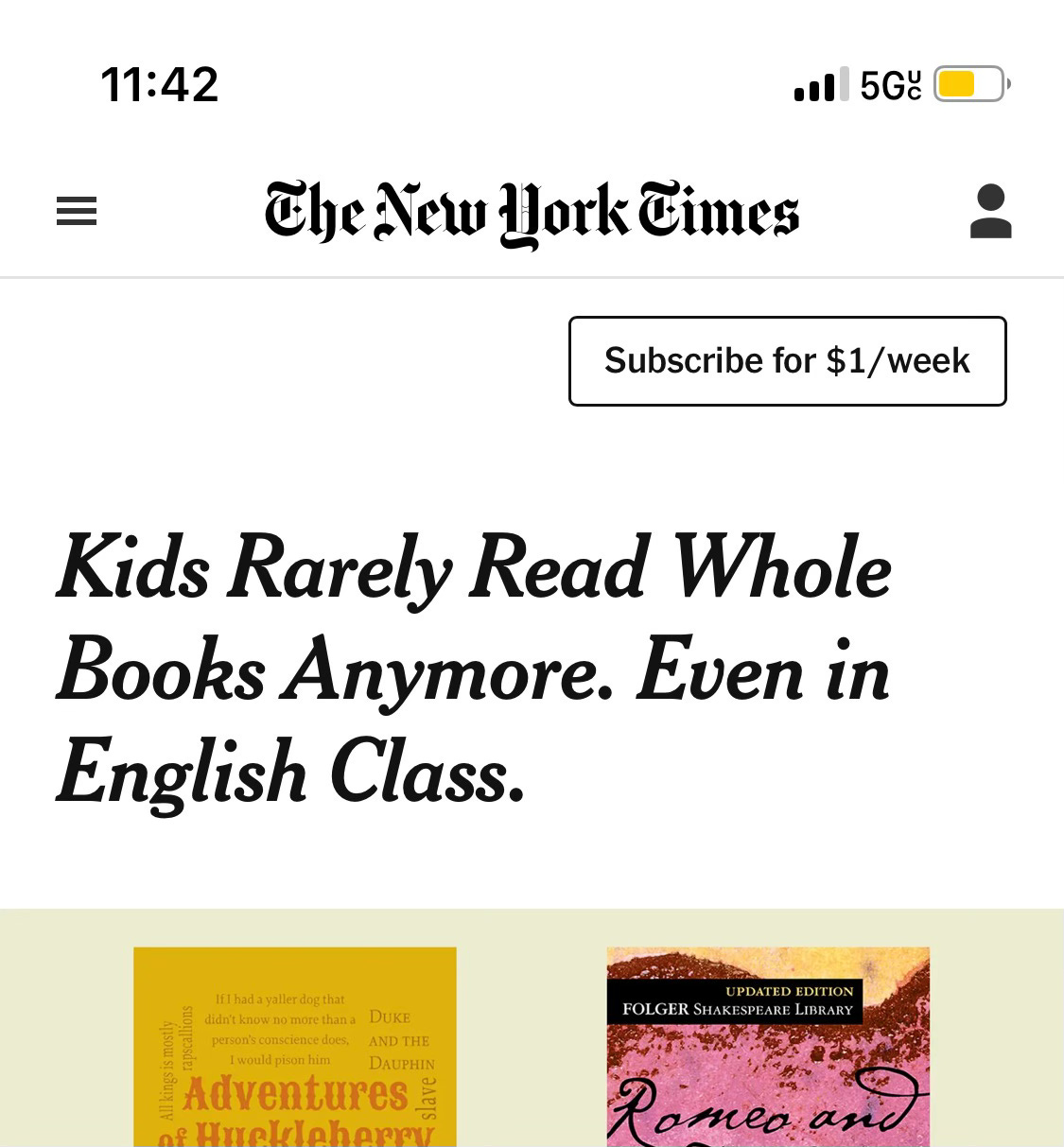
My thought? Way to get with the times, New York Times. This has been going on for years. It’s a problem that actually looms large in my novel Why Teach? which is set in the late phases of the No Child Left Behind act, just after the 2008 financial crash, so we’ve been dealing with this for more than a decade and a half now. The problem originated in diverse, low-SES schools, though, and has only migrated to more affluent, majority-white schools in the last five or ten years—perhaps this is why it’s newsworthy now? Or perhaps it’s just the degree to which the problem has become so widespread: the strategies low-achieving schools once used to pass state tests have become normalized as more districts try to squeeze out higher scores to appear more effective.
And so I’ve moved my “How I’m Teaching This Year” piece back in the rotation and am pushing forward “How to Teach Without a Textbook,” because textbooks, believe it or not, are an important part of this growing problem.
It’s obvious if you think about it, but I suspect a number of people outside of education don’t realize what a big deal “textbook adoption” is for schools. A great deal of time and money goes into this process, and textbooks, after purchased, hold an enormous sway over the curriculum and what is taught.
The problem is complicated. I’ll start here: the textbook, in addition to the written curriculum, is one of the new teacher’s most valuable allies. Students of education pick up a great number of credits on pedagogy—read: general knowledge of teaching—but many of them emerge from their undergraduate and masters programs with a relative paucity of knowledge about their specific content areas.1 Coming into the classroom after their undergrad degrees and a mere semester of student teaching, many of them are learning much of their subject matter alongside their students.
What happens, then, when the textbooks become aligned not to teaching students to read literature for the sake of being literate and understanding the world around them but rather for the sake of simply passing short passage and multiple-choice tests?
Filling textbooks with shorter passages and multiple choice tests—and pairing them with online “tools,” passages, and banks of questions—makes them an attractive product for districts who who want to improve their statistical reading scores, but do these tools actually help students become readers? And is there a difference between being able to pass tests and actually becoming a literate member of society?
Literate was once a word that meant a person had read great books and was capable of applying the lessons of these books to their lives. Great books are great—they are chosen for the cannon—because they give us lenses to look more closely at earlier phases of our history, our human condition, human psychology, and the excellence human beings are capable of in their creation of art. Teaching The Great Gatsby sets the stage for a teacher to help students think about the 1920s as a time of exuberance (The Jazz Age), but also a time of rudderless hedonism (The Lost Generation). It lets us ask questions like, Did prohibition work? Do zero-tolerance policies work? (Did the war on drugs work? Did the left’s recent campaign of cancellations work?) …What did our history teachers mean when they said “The stock market crash of the 1920s was precipitated by rampant and irresponsible speculation.” Should we look into that? Could we, a hundred years later, be guilty of the same? Is our present generation, similar to the ‘lost’ generation of the 1920s, rudderless? How can we correct for that?
I could conduct similar exercises with books like Of Mice and Men to discuss the depression of the 1930s or Death of a Salesman to talk about the middle class of the 50’s (and the phenomenon of the American middle class in general).2
But when the standardized testing era has redefined Literate not as having read the great books and being capable of applying their lessons to one’s life, but instead merely being able to read, then teachers stop teaching great literature and students stop reading it.
Today’s textbooks are a far cry from the textbooks of a mere twenty or thirty years ago, and the difference is the intent of their design. “Design with the end in mind” is a popular concept in many fields, including engineering and business. It makes an awful lot of sense. The “end” the old textbooks were designed for was well-read, educated students who are familiar with history and literature and ready to take part in our complex democracy today. The “end” that the new textbooks are designed for is students who can pass their state and national reading tests. There is an enormous difference between these two ends.
Perhaps as bad as the narrow “end” that these books aim for is the fact that many of them are sold in “consumable” fashion: that is, they aren’t hardcover books with long texts that can be used year-after-year for more than a decade, but rather floppy-covered workbooks that allow students to do annotations and worksheets for page after page.
Don’t get me wrong, I love highlighting and annotation activities, but teachers who assign them day-after-day are engaged in tedious and disingenuous instruction. They have ceded the obligation of actually engaging with and teaching their students and have become, instead of teachers, mere government functionaries akin to DMV workers. Told to teach from the textbook, early-career teachers aren’t given the ability to really teach; they cannot grow as educators and develop their craft. Much attention has been given in recent years to bad student behaviors and lack of administrative support driving young teachers from their classrooms, but much of the frustration and disillusionment of early-career teachers today, I believe, actually has to do with feelings of meaninglessness and ineffectuality. Part of the compensation package for teachers is that, if they aren’t paid as well as peers who go into “harder” science-based careers or business, at least they get to feel like they are doing something meaningful and make a difference. The way education is delivered today, with teachers reduced to functionaries and overseers, this cannot be the case.
On top of this engendering of meaninglessness, many of the pages of these “consumable” books are never even used. Teachers who know that they will never use much of this paper product reluctantly get carts to haul boxes of these books to their classrooms every August and then put the partially used workbooks back onto carts to haul them to the dumpsters in May or June. It’s an ecological nightmare.
And the “online features and tools”? These are largely just workbooks posted online. Some of the quizzes may be self-grading—and there might be the benefit of some immediate feedback for highly motivated students—but students have often learned to pass screenshots of the correct answers to one another, or retake quizzes with unlimited retakes over and over again marking their right and wrong answers until they unlock the “key.’ Additionally, there are a host of technology-related problems that come with these tools: “join codes” for classes; the trouble of what to do when the network suddenly goes down; difficulties with students who come to the district late or transfer between classes; students, already subject to far more screen time than they should experience, subjected to more screen time in their classrooms; students, assigned work on their computer, purposely or inadvertently using their ‘phantom hands’ to open other tabs to shop, watch videos, or check fantasy football statistics… All of these problems without even getting into the way that some large state school boards have inordinate and inappropriate sway over what goes into textbooks!
And so my answer to the problem: districts shouldn’t buy today’s textbooks. Teachers invited to committee meetings on textbook adoption should argue that they don’t want or need them. The tremendous amount of money that districts pay for these books should be redirected to purchasing actual novels and plays—cheap Dover editions have good footnotes and can last a long time. More expensive products from Norton and the like can have hard covers and include valuable supplementary material. In addition to novels and plays, there should be anthologies of short stories, poems, and essays. Better yet, teachers should find contemporary, free texts from valid sources online. Some of these are out of copyright, like Emerson’s “Self Reliance,” Thoreau’s “Walden,” The Declaration of Independence, and various essays by the likes of Payne, Virginia Woolf, Mary Wollstonecraft. Some contemporary essays are available free from publications such as The New Yorker, The Atlantic, Harpers, and even Substack! The Electric Typewriter is an outstanding clearinghouse of contemporary, much-discussed essays.
Anchoring the curriculum in valid longer works, be they novels like Frankenstein, plays like A Raison in the Sun, or nonfiction biographies and books like Freakonomics or Outliers leads to sustained reading, continuity between classes, and an achievement of depth: sustained, deep investigations of ideas that facilitate the critical thinking skills of analysis, evaluation, and synthesis. The popular expression a mind is not a vessel to be filled but a fire to be kindled has been used to justify the removal of content from curricula in recent decades, but a fire cannot be kindled without fuel as a substrate, and the contexts that longer texts equip students with are a fuel that students need. The contemporary short-passage, skills-work textbook, which has too often become the primary fuel for the contemporary English class, is a poor, expensive, wasteful, and counter-productive fuel for student thought in comparison to the “fossilized” texts we have thrown out.
Classes built around longer works need not cease to be based around “thematic” units—thirty years ago it was common to anchor thematic units to novels and plays. Likewise, these classes can still obviously teach students skills. But to be clear: mere skills aren’t want students want or need. They’ve been born into a world of ideas and they occupy a remarkable and interesting point in our history. They need context. They need to know what has come before them; they need reference points to understand all of the ideas everyone around them is arguing about. To only teach excerpts, short pieces, and skills from textbooks that have really become glorified workbooks is to miss the forest for the trees and underserve our students egregiously.3
My novel Why Teach? received a fantastic write-up from Substack’s Woman of Letters Naomi Kanakia last week, and I’ve enjoyed a rash of sales since then. Between Kanakia’s review and the New York Times article I’ve mentioned above, I’m feeling especially relevant at the moment. If you’re interested in literary fiction, novels set in small towns, coming-of-age tales about twenty-somethings, or the bureaucratic overrun over our public schools in recent decades, I hope you’ll consider picking up Why Teach? Kanakia called it “artful,” “unsentimental,” “so good,” and, in bold, wrote “there is nothing else like this book.” Her review is here:

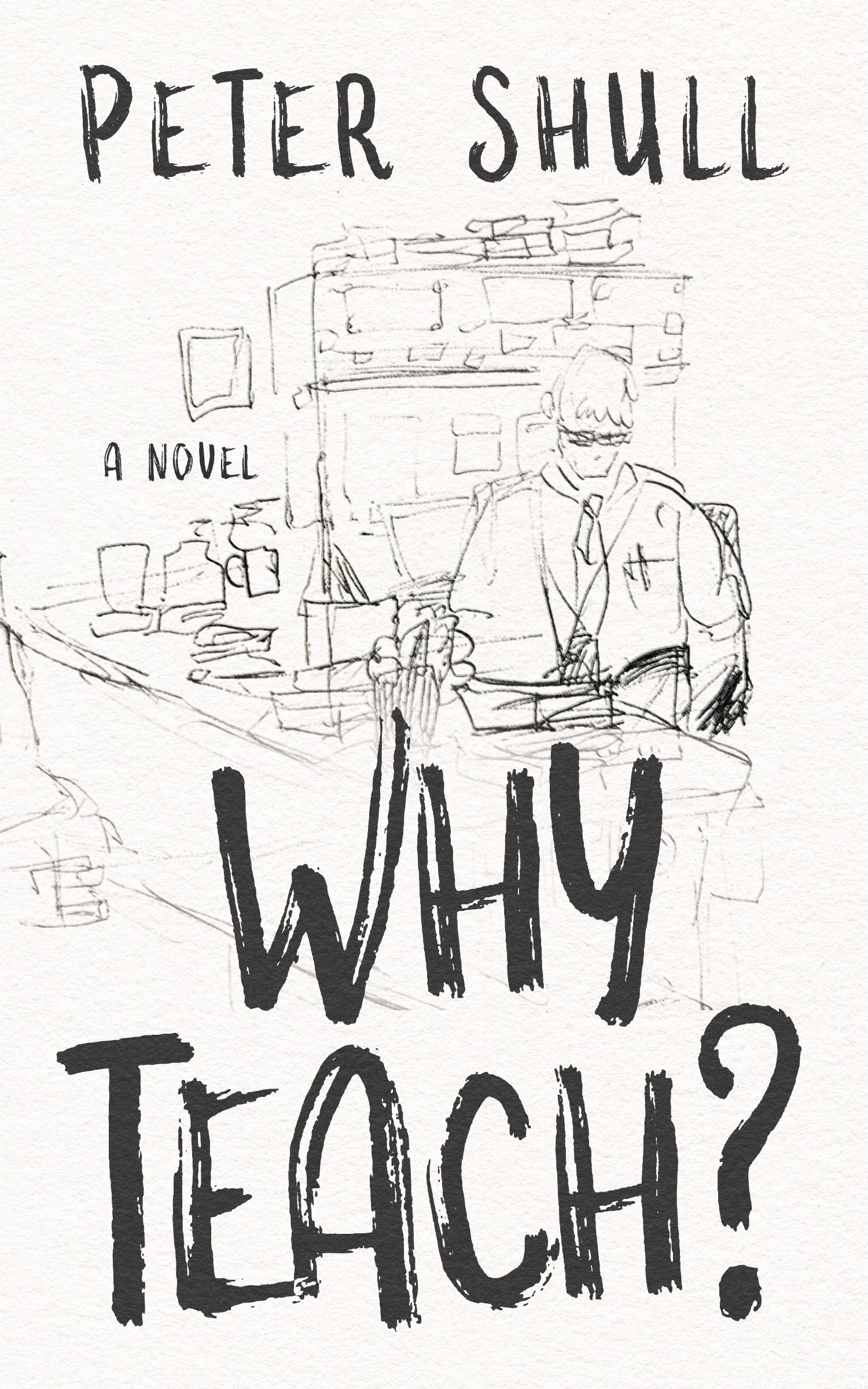
Peter Shull is a novelist, short story writer, and educator. His novel Why Teach? is available for purchase at Bookshop.org, Barnes & Noble, Amazon, Kindle Store, and Kobo.
As a ‘nontraditional’ teacher with an undergraduate degree in English, I have far more credits in English than the typical education major who plans to teach high school English. I don’t say this as a ‘flex’; rather, I’m concerned that an awful lot of English teachers don’t know enough about their subject matter—I’ve literally seen teachers who didn’t know nouns from verbs. Teacher training, to my thinking, is far too homogenous. Primary school teachers, middle school teachers, and high school teachers each have far different experiences but are subject to much of the same pedagogical coursework. Likewise, much ‘research’ applied to certain grade levels and subjects is generalized across all grade levels and all subjects, which strikes me as largely inappropriate. The term ‘research-based’ is thrown around often and loosely in education; I feel like the people throwing it should be showing up with studies in-hand so that the practitioners expected to make use of these strategies can see what this research actually addressed.
Miller’s engaging play The Crucible, to continue the above list, is great for talking about McCarthyism, group think, fear, and the dangers of charismatic demagogues in our society. Want to surprise students with an unexpected look at privilege? Try Toni Morrison’s Song of Solomon. Want to hit them with the dangers of self-interested “bad actors” and the dangers of having a big, brittle ego? Othello.
But how do you do it? some of my readers might be asking. How do you teach a novel or a play? Here’s a quick primer: you spend about a half class period or a whole one building background with historical contexts and perhaps some relevant vocabulary; you read the first page or a few with them to point out the motifs that are introduced and/or the questions that are asked. You explain that to read a long work is to engage in an act of faith that the questions the early point raises will be answered in the rest of the work, and moving steadily forward will be rewarded. You set a reading schedule to try to finish the work in 3, 4, 5, or 6 classes. You pick three, maybe four main focuses, skills, or lessons you want to get out of the text. You never aspire to teach exhaustively—it’s a recipe for disaster. Instead, you tell them you are shooting for ~80% understanding. You give did-you-read-it, knowledge-level (not ‘inference-based,’ drawing conclusions, or other high-level ‘skill’) reading quizzes intermittently to keep the kids honest. (I give short answer quizzes, two-four lines per answer, typically two or three questions: they’re harder to look sideways and cheat on.) You start your clarifying lectures not based on plot, that is, what happened, but character, that is, what’s going on with each character. Assign socratic discussions, supplementary texts, and writing assignments as you see fit.
Very interesting to go from a student to reading your Substack at 1AM… Currently I am going through a Music Education major at KU and find it interesting how in my music education, we were taught out of fundamental books then transitioned to… nothing! We learned to play our instruments on beginner books then just played pieces and had bits of content about musical basics—never more content. Now being on the other side of the two way interrogation glass—I see the wealth of knowledge that is available… that is often not used (at least not for me). By my senior year we had gotten to reading out of a book more which was nice… I suppose my question is—What do we do about the teachers that don’t have the time/knowledge/ability to put together thoughts to properly form lesson plans? What do we do when people care less than us? (No diss on my colleagues…) Do we set statewide standards? (this is kinda the path I’m moving towards)
How do we ensure better education across the board when teachers don’t have the ability to put together curriculum on their own? Do we choose textbooks or set standard curriculum (or maybe a secret option I haven’t discovered yet)?
((Forgive the—I’m sure terrible—grammar, it’s a process 😭))
I'm a young teacher just coming out of his 20s so I think I need to buy your book and read it asap 😂. This was a great read, one that will inform my practice after the break. I teach social studies and have similar concerns about the loss of content teaching. I'm very grateful I studied political science and history in college and then did a traditional teacher education program because now I know my content and it has set me up for pedagogical success.