

Men Need Stories
An Interview with Alex Muka

Stories. Men need stories.
What did you think I was going to say?
In the last quarter of
’s novel Hell or Hangover, protagonist Lou “Professor Lou” Kennedy does an incredibly misguided and noble thing: he goes to the strip club where his friend ’s now-fiancee formerly worked and gets four (four!) lap dances (from four different women) so he can “investigate” his friend’s betrothed. Four!This is a hilarious thing, and also, I think, instructive. It’s hilarious because, well, four lap dances for an “investigation,” and instructive because, well, men can be idiots. Men, like all people, but maybe especially men, learn as much from negative examples as we do positive ones, and Muka’s novel abounds with Lou making what we in the literary world call “intelligent mistakes.” There are rhymes and reasons for what he’s doing—they’re just wrong rhymes and wrong reasons. If the purpose of literature is, as Richard Russo suggests in the introduction of The Best American Short Stories 2010, “to entertain and instruct,” then Alex Muka has written a supreme example of literary fiction for the twenty-first century man: Hell or Hangover is uproariously entertaining, and if learning how to act by watching someone behave badly is instructive, then it’s also enormously instructive.
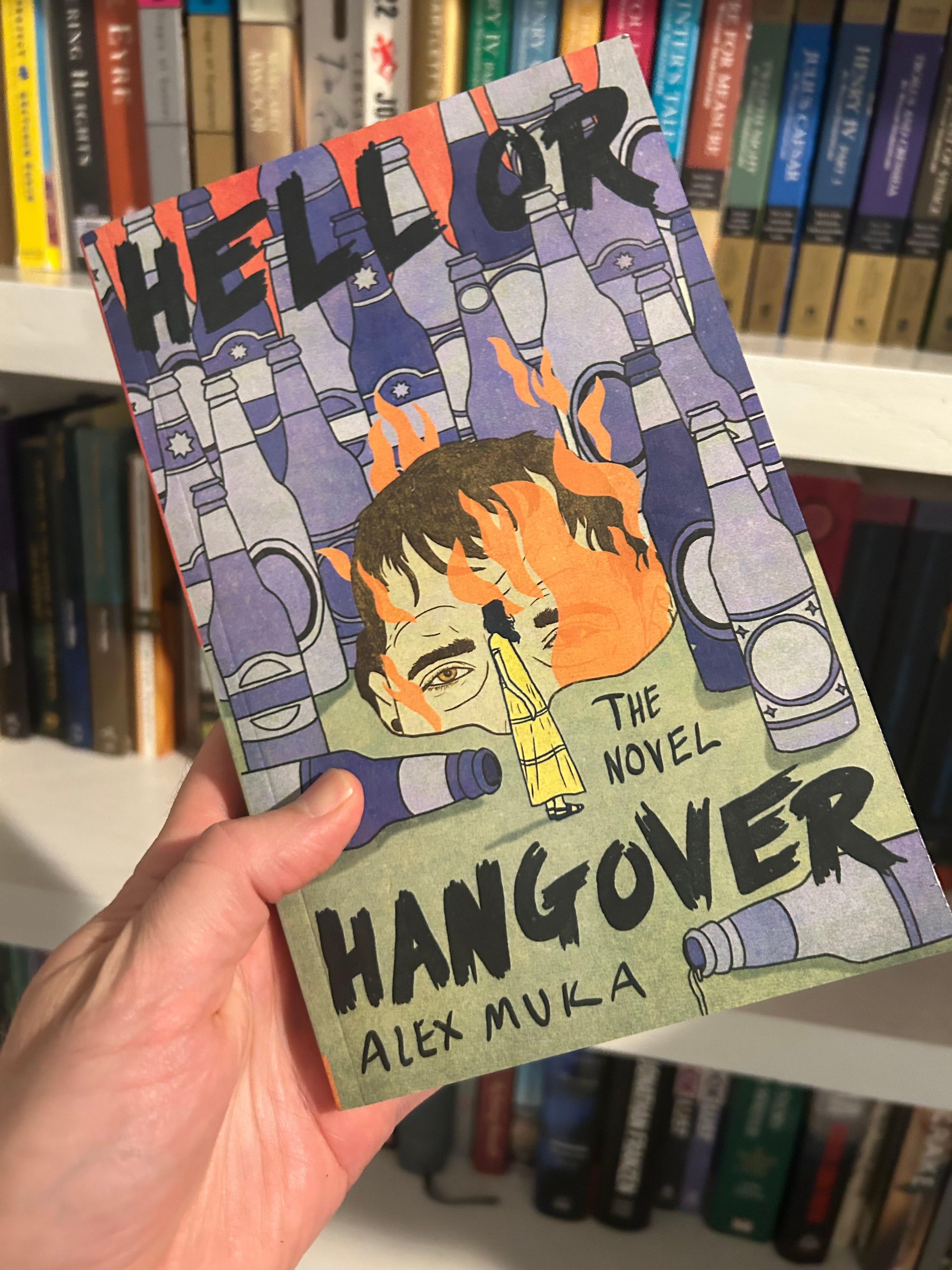
Muka’s book is a comedy. I feel compelled to say this because, perhaps based on the title, or perhaps because of all of the bottles and the flames on the cover, I’ve seen reviewers who seem to think the book is supposed to be… darker? If one comes to the book looking for a gritty, desperate novel about the basements and other nether regions of hardcore addition—well, they’re going to be disappointed.1 The book is not only a comedy, but it’s a romantic comedy. Professor Lou—the thing he mistakenly thinks he’s an expert on—the thing he shares his “wisdom” about with his large Twitter following—is love and relationships. Lou can be guilty of being pretty cynical about things, but is, deep down, actually a pretty romantic guy. In the course of a week that begins with his attending a party at his sister’s and meeting ideal, angelic Marissa—then sees him returning to a state of intoxication over and over in hopes of meeting up with Marissa again—Lou is brought low, has some rough experiences, and learns a few things. So don’t think Raymond Carver. Don’t think about the Denis Johnson of Jesus’ Son. Hunter S Thompson is a little closer with the ‘gonzo’ antics, but the best antecedents I can think of for Muka’s book might be the popular “raunch-com” movies of a couple decades back. Think Knocked Up, Wedding Crashers, 40-Year-Old Virgin, or The Hangover: movies that, beneath their candy-coated shells of irreverence and misbehavior, actually featured hearts of gold.
I don’t imagine Muka is going to flex his presumably muscular traps and bring his shoulders to his ears in embarrassment at my characterization of his novel as romantic. The man, I’m sure, knew what he was doing. A former high school football team captain and collegiate ballplayer, those of us who follow him on the platform know he’s funny and has a heart of gold. He’s a married man with kids—believe it or not, this is a dream many men harbor. We like romantic comedies—particularly raunchy ones. They’re an awful lot of fun and can give insight into the proper and improper ways we might navigate the complex social waters of this complex world we’re living in. Life was confusing before social media. Muka, by way of Lou, is here to offer some guidance to those who are lost. Check out his book, friends. Professor Lou is putting class into session.
Alex’s substack is here, and there are links to order his book at the bottom of this post.
The audio recording of the interview is below; the written transcript of the interview follows: just press that orange ‘play’ button.
Nine questions for Alex Muka:
Alex! Thank you for letting me interview you! First of all, tell us about yourself: How should we know you? How do you want to be known?
I really appreciate the opportunity, Peter! I don’t know if you remember we first came in contact because you liked one of my Substack posts and then immediately corrected my grammar in the post. I appreciated that haha! But yea, my name is Alex Muka and I’m a father, husband, and writer living in Red Bank, NJ. I started my Substack called Hell or Hangover about a year and a half ago and some people might know me from that but what I would like to be known for is my novel by the same name – Hell or Hangover.
One of my favorite things about your novel is the tight timeframe. I love novels of a week, a weekend, even just a day. Yours fooled me: at first I thought it was going to be a novel about one night, but it turned out to be a week. Tell us: how did you decide on this tight timeframe for your book?
The tight timeframe came from this thought that wouldn’t leave my head once I got the idea for the novel - what if a guy that is terminally online, aka a millennial, met a girl in real life and then didn’t get her phone number or couldn’t find her online or didn’t have any tangible photo evidence that the night happened? Would the guy start to think he made it all up? The reason I landed on a week is because that’s just a funny enough amount of time for the story to seem as ridiculous as it is. Like really…a week? You haven’t heard from the girl in a week and you’re driving yourself insane? I think it really highlights the toll instant gratification takes on people. Back in the day people wouldn’t bat an eye not hearing from someone they were interested in over a week’s time. But the dating game was much different in 2015 than in the 90’s and I can’t imagine what hellscape the dating scene resembles now.
For a person who spends a great deal of the book inebriated (by the fifth and sixth days, sometimes it hurt this reader to see Lou picking up a pair of shots and chasing them with a beer), your character is tremendously introspective—can you tell us about your choice to write this book in the 1st person instead of the 3rd? I’ve heard you mention Jay McInerney’s Bright Lights, Big City a few times. Did you think about 2nd person for this book?
I never thought about any other person than the first. There are a couple reasons for that. First, if you didn’t get inside Lou Kennedy’s head, and I mean directly inside, the reader would have had to judge him on some other merit. If the reader didn’t know what Lou was thinking Lou would be 0% likeable. Maybe even less than 0. His actions aren’t very likeable, especially in the beginning of the novel. Sure, he’s charming and fun and funny but in general, he’s an ass. Without getting inside his head, without him revealing that he knows he’s an ass and that he’s not particularly proud of that, there would be zero reason to root for him.
Another reason is that he’s losing his mind on the hunt for this girl. He shouldn’t be, because it’s one damn week, but he is. And the only way to make this feasible, to convince the reader that his insanity is real, is to put the whole book inside Lou’s head. So the reader can see that yes, he is losing his mind, but also, oddly enough, there are valid reasons for that.
But, if I’m being totally honest, I never really thought about any of this until I sat down to answer these questions. I just wrote the story. And first person fit the story. I love a good character voice. I might never write outside the first person because a character’s voice is what I love most about writing. A novel I’m toying with right now has possibly three first person voices. Not present tense though. The whole point of a book, to me, is to get into someone else’s head and there’s nothing better for that than first person.
Speaking of Bright Lights, Big City, tell us about your literary influences! Who inspires you? Were there any works that were touchstones that you revisited when you were writing Hell or Hangover? How did they help you?
This question leads perfectly from the last one because Jim Harrison is my favorite writer of all time and I remember he said in an interview something like, “How else do you get in a character’s head without writing in first person?” So maybe that had something to do with the way I write. Jim Harrison is never ending inspiration for me. Between his poetry, non-fiction, novellas, and novels I think he’s the best writer of all time and doesn’t get nearly the respect he deserves. He has a very meandering style though. His characters often have random thoughts that go off into little illuminating tangents. This is something I ended up curtailing in my book. Hell or Hangover was originally 50k (okay fine…75k) words longer than the version I ended up publishing. That meandering type of writing wasn’t what the story needed. The book is a shot, not a beer.
I always mention Bright Lights, Big City as my biggest influence because it was the first book I read where I knew I wanted to do whatever it was that that book did. To me it’s a perfect novel. The right amount of dirt mixed with great writing. I could write about dirt all day (hangovers, fucking up, booze, drugs, etc…) but to do it in a way that still reads beautifully is tough. I constantly went back to that book while I was taking breaks from Hell or Hangover. That and Great Gatsby for some reason. I wanted to tell a story about my generation the same way Fitzgerald told one about his. My book is clearly nothing like Gatsby but I wanted to convey that same feeling of a time in history. All that being said, I never read something too on the nose while I’m writing because I start catching myself writing in that person’s style. I can’t do what other people have done better than they have. I have to do my own thing my own way.
My latest favorite writer is Jake Arnott. If this guy doesn’t do grime perfectly, I don’t know who does. The man is fucking brilliant. His most famous book is The Long Firm followed by two more books in the loosely defined “trilogy” plus a few more. His new one Blood Rival is out in October. Very British. Very dirty. Very fucking awesome. Who wouldn’t want to read about a very terrifying and very gay gangster in 1960’s London? Highly recommend.
5) I’m a novelist, myself, and many in my audience are working novelists. Tell us about both 1) your education as a novelist, and 2) your process.
My education in writing is none. I graduated from college with a degree in Software Engineering. I’ve always loved to read and then I just started writing because I wanted to see if I could do it. Then I realized I loved it. Then I got obsessed with it. I have mixed feelings about education. Part of me wishes that I had read the classics and knew what realism, or modernism, or romanticism meant but that’s not the way my education went. One time I sent my first page of Hell or Hangover to a pitch conference and the woman that read it out loud, to a group of 30 people, said, “That first line makes me think this guy has read too much Plato.” I laughed out loud. I think she was referring to The Cave? I wouldn’t know. I’ve never read a fucking word of Plato. I’m not proud of that, it just is what it is. The other part of me is glad I don’t know these things. It frees me up to write however I want, about whatever I want, without overthinking it.
I guess that’s where the process comes in. I write in the very early mornings, which is the only free time I get throughout the day with two little girls running around. In the morning, I write long hand. I feel like it’s a better connection for me and my brain to write that way. Also, I don’t want to look at a computer more than I have to in a given day (which is normally 8 hours). Then at night I type up what I wrote, editing a little as I go. When I have enough, I print out the pages and edit them with a pen on the printed pages. I try to write as little as possible on the computer.
I’m the same way with reading. I started reading your book on Substack and realized I just couldn’t get into it the way I liked on my phone. So I printed out the first couple chapters, loved them, and waited impatiently until the paperback came out and read it in a couple days!
One of my favorite things about the book, arriving in the first few pages, is its… multi-dimensionality, by which I mean Lou is present, but his presence in the moment is always at the intersection of his past, his interiority, the expectations he knows he must meet for his friends, and his robust online presence. Can you talk about the importance of online life as it’s reflected in this book? (Are any of us really present in our physical lives when all of us have such prominent online lives to think about now?!?)
Like I mentioned earlier, the entire premise of the novel was based on this idea of a guy losing his mind because he can’t find a girl online after meeting her in person. When I was in the dating game the first thing you would do after a night out, if you didn’t get lucky, was to look up the lady you were interested in. You’d check her Facebook or Instagram or Twitter or whatever new social media app that was hot at the time. In a weird way you could get to know them, see what they liked, what they didn’t like. In theory, this is a good thing. But in reality, it just kills all the romance. Because you think you are getting to know them better but you’re not. You’re getting to know this persona they portray online that isn’t really them, is it? No one posts their anxieties, their innermost thoughts, their worst fears, online. Well…at least they used to not do that haha! That’s one thing that’s really changed in the past decade online. Now we have the sympathy fucking Olympics everywhere you look.
But regardless, getting to know a real person can only be done by spending real time with them. Learning their quirks, knowing their tics, knowing their deepest darkest shit and loving them anyway. That’s what life is about. Online life is fake. It’s best just to have fun with it. Don’t take it too seriously. Because I know that not a single follower or subscriber (that don’t know me personally) are going to show up to my funeral and know the real person in the casket. This might sound corny but cherish the people who know you, warts and all, and still decide that they love you. I could fuck it all up with a bad Substack note but my wife and my kids and my parents will still love me (depending on how bad the note is).
Lou is a modern man—an educated modern man who can reflect back on his experiences in Soc 2200: Working Women and make casual reference Anais Nin—and he threads the needle between coming across as stereotypically masculine and misogynistic and sensitive and sympathetic. Can you talk about how you worked to achieve this? Any commentary you’d like to share on contemporary masculinity? How should a man BE today in 2025?
I’m happy you think I threaded this particular needle because it’s something that bothers me about the whole conversation about men. Men are a lot of things just like women are a lot of things just like people are a lot of things. That’s the whole point of fiction in my estimation. Every person is so fucking different and that’s what’s great about reading. You get to put your head into someone else’s, someone that’s wholly different from yourself. I’ve been put into a lot of boxes in my life. I played football. I was the captain of my high school football team. So what are your first thoughts about me? Asshole. Jock. Meathead. I have white skin. I grew up in the suburbs. I work for a company my parents started. So what are your first thoughts about me? Asshole. Entitled. Rich kid.
So now that you’ve made your easy opinion on who I am as a person you can put me in this little box over here and go on with your day thanking the good lord you didn’t buy Hell or Hangover. I guess it makes it easier for people to do this in a world filled with a billion people. But it’s just foolish. I was the captain of the football team but I brought the last Harry Potter book to camp my senior year when it came out. I got so much shit for it but did you think I wasn’t going to read the last Harry Potter the second it came out? Fuck off. My skin is white but my grandma was born in the Dominican Republic. I cook sancocho and ropa vieja. I grew up in a very Hispanic household. So what do you really know about me?
To come back to the question about masculinity my answer is that each man’s version can be different. You can have the stoic dude or the affable dude or the skinny dude or the jacked dude or the bachelor or the married guy or whatever it is, it can come in a million different shapes and sizes, just like femininity. My wife was a tomboy all her young life. She puts the Ikea shit together in the house. I look at those directions and go dizzy, my wife looks at those directions and gets a hard on. Does that make me less manly? Well, yea, probably, but I’m still her man and she’s still my lady.
All I can say is that I know a man when I see one, when I talk to one, however it comes. I’d say masculinity can probably be distilled down to one thing – confidence in who you are and not giving a fuck what anyone says about it.
8) Lightning round: pick one, or tell us about some combination of all three: food, wingmen, or comedy in fiction.
Cuban food is drastically underrated. Wingmen are drastically underappreciated. Comedy in fiction is drastically missing in the current state of literature.
Finally, Alex, tell us what you’re working on now! What’s coming up next from Alex Muka? How soon can we hope to see it?
I have a few books on the shelf I’m ready to dust off and edit. One is the first in an eventual crime/mystery series involving a guy who does odd jobs to fund his surfing addiction. Another is a literary-ish speculative novel about marriage. But for some reason one character won’t leave my head and I might have to shun these editing projects for him - a bookie from New Jersey.
Alex Muka’s novel Hell or Hangover is available on Amazon, Bookshop.org, Barnes & Noble, and wherever else books are sold!
Peter Shull is a Midwestern novelist and short story writer. To support him, consider buying his novel Why Teach?, a story of youth, education, bureaucratic absurdity, and hope. The first chapter is available to preview here on Substack, and it’s available for purchase at Bookshop.org, Barnes & Noble, Amazon, Kindle Store, and Kobo.
If one is looking for a writer who does a good job of addressing the darker realities and hardships of alcohol and drug addiction, my Substack recommendation is
, whose fiction reads like a contemporary Bostonian Raymond Carver if Carver had dealt with harder drugs. My interview with Desmond is here.
Nice job fellas. Please put me down for an ARC of the jersey bookie memoir, er, novel.
I’m back, Peter. Great post. More later.